
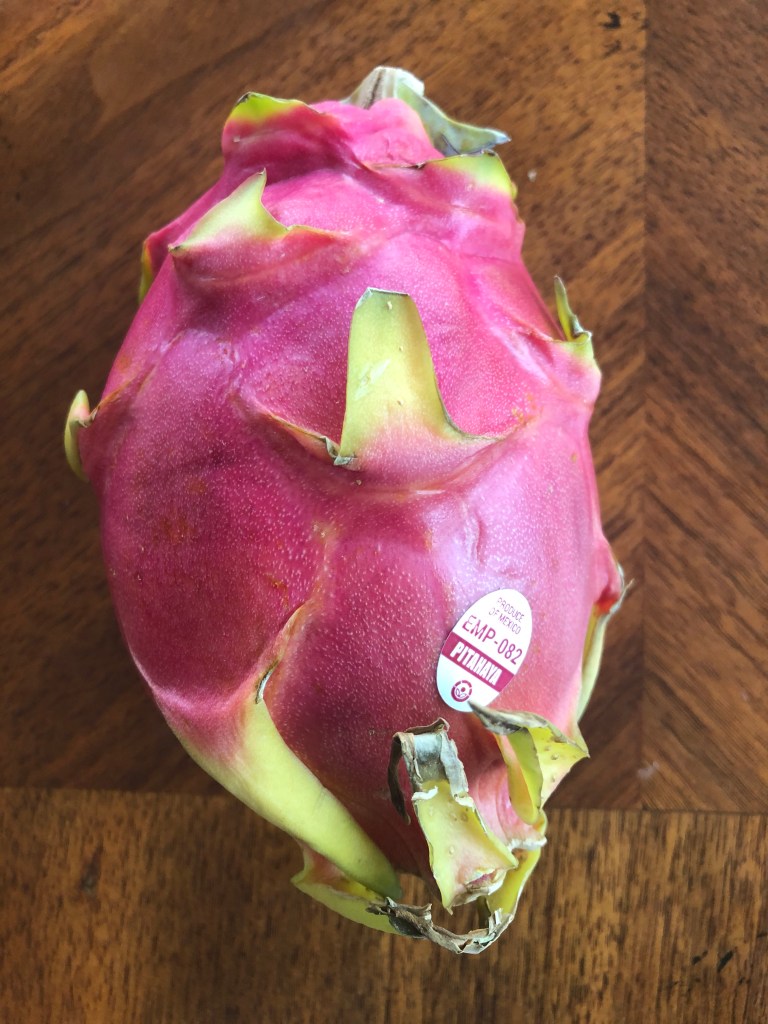
The task of picking out a fruit or vegetable that I had never consumed before was a challenge, because I felt like I had tried basically every fruit and vegetable there is, but after taking a trip to my local H-E-B, I noticed an odd-looking fruit. What might be even more odd is the name for this weird fruit: dragon fruit. Why would they name this dragon fruit, I thought?
I have heard of dragon fruit before but cannot recall where. Maybe I have seen it on the menu in a salad dish or in a smoothie, but I cannot recall a time where I have actually tried a dragon fruit. So, I decided this was going to be the first time to sample this lesser-known fruit.
To give a little background to what dragon fruit is, the dragon fruit grows on the Hylocereus cactus that is mainly found in Mexico and Central America but is grown all over the world. I looked at a few reviews of the dragon fruits flavor, and most described the taste of it as sweet and delicate, with others even labeling the fruits flavor as “tropical.” The dragon fruit supposedly has little seeds, similar to a kiwi.
I watched a short YouTube video to learn how to properly cut and eat a dragon fruit. Basically, you must cut the fruit in half, then cut each of the halves in half, and then from there when you have four pieces, peel the skin off the fruit. This was my plan going into tasting the dragon fruit for myself.
I set out a cutting board and a knife in preparation to eating the dragon fruit. The dragon fruit skin certainly had a rubbery texture. I thought it would be difficult to cut the fruit due to its size and what appeared to be a thick layer of skin, but it was incredibly easy to cut.
The appearance inside was the same from what I viewed in the YouTube video. I still was shocked to see how many little seeds were in the fruit, even though I saw that from the YouTube video, but I had never seen a fruit with so many seeds, and with seeds that little. Even one of those “Cuties” small oranges have bigger seeds!
The texture of the inside, along with the appearance was remarkably similar to a kiwi. I was somewhat surprised by how strikingly similar the dragon fruit was to a kiwi, especially due to that the inside appears nothing like the outside of the dragon fruit, but I did expect it to be a similar texture to other fruits I’ve had before such as a kiwi, or a strawberry, or pear due to that it was deemed as sweet and tropical in reviews.
I cut the fruit into four separate pieces and peeled the skin off the piece I was going to consume first. The skin came off very easily, exactly like peeling a banana, and as stated before, it was a smooth cut. It was time for me to find out what the dragon fruit tastes like.

I ate a piece of the dragon fruit and must say that it was good and felt like eating a kiwi. It didn’t blow me away in a sense like “where has this been all my life,” but it was good, nonetheless. It was sweet but watery, not quite as sweet as a kiwi or most other fruits. I would compare its level of sweetness to a cantaloupe. The small seeds that are scattered throughout the fruit made the fruit feel crunchy when eating it, like eating a crunchy kiwi, if that makes sense. Overall, I am glad I finally got the chance to try a piece of dragon fruit. This fruit that is known as a dragon fruit due to its dragon-like appearance (this is debatable) may look complex and intense from the outside, but on the inside, it is sweet, tropical, and quite tasty.
 Baker Bytes